Cellulite on your legs is one of the most common skin concerns, and also one of the most misunderstood. If you’re eating well, staying active, and still noticing that dimpled texture on your thighs, you’re not doing anything wrong. According to research, cellulite affects 80–90% of post-pubertal women, regardless of body size, fitness level, or lifestyle.
If you’re looking for how to reduce cellulite in legs, there are some natural approaches that can be effective and others that are largely myth. For persistent cellulite, professional treatments offer the most clinically supported results.
Here’s what the evidence says.
Key Takeaways
- Cellulite is a structural skin condition, not a sign of poor health or low fitness
- Natural methods (exercise, hydration, dry brushing) can reduce the appearance of cellulite, but won’t eliminate it entirely
- Many popular remedies (wraps, scrubs, tight leggings) have little to no clinical evidence behind them
- For stubborn cellulite that doesn’t respond to lifestyle changes, non-invasive professional treatments are worth exploring
- Individual results vary; there is no single guaranteed fix
What Causes Cellulite on Your Legs?
Cellulite develops when fat cells beneath the skin push upward through fibrous connective tissue bands (called septae), creating that characteristic dimpled, “orange peel” texture.
In women, these connective tissue bands run vertically, making the skin more prone to this kind of protrusion. Men’s connective tissue runs in a criss-cross pattern, which is why cellulite is far less common in men, affecting fewer than 10% of the male population.
Several factors influence how pronounced your cellulite concern is:
- Genetics: Your connective tissue structure is largely inherited
- Hormones: Oestrogen plays a significant role in fat distribution and skin structure
- Age: Skin loses elasticity over time, making existing cellulite more visible
- Body Composition: While lean people can absolutely have cellulite, higher body fat can make it more noticeable
- Circulation: Reduced blood flow and lymphatic drainage can worsen its appearance
This is not something caused by eating the wrong foods or skipping leg day. It’s largely structural, and that’s important context for setting realistic expectations.
What Natural Methods Can Actually Help?
There’s no natural remedy that will permanently eliminate cellulite, but several approaches have supporting evidence for reducing its appearance over time.
Strength Training and Cardio Combined
This is one of the most evidence-backed strategies for how to reduce cellulite in the legs. Building muscle beneath the skin creates a firmer foundation, which smooths the surface appearance.
Fitness researcher Wayne Westcott, whose work examined exercise and cellulite reduction across multiple studies, found that about 70% of women who followed a programme combining strength training, aerobic exercise, and dietary changes saw significant improvements within two months. It’s worth noting that dieting without strength training can actually worsen cellulite by causing muscle loss, so resistance work matters as much as cardio.
For how to tone legs and get rid of cellulite, focus on compound movements: squats, reverse lunges, Romanian deadlifts, step-ups, and hip thrusts. These engage the glutes, hamstrings, and quads simultaneously.
Hydration
Staying well-hydrated supports skin elasticity and reduces the sluggish circulation that can make cellulite look worse. While water intake alone won’t structurally change your connective tissue, dehydrated skin appears thinner and less firm, making dimpling more obvious. Aiming for 2–2.5 litres of water daily is a simple, low-effort habit worth keeping.
Anti-Inflammatory Nutrition
A diet rich in vegetables, fruit, lean protein, and healthy fats supports collagen production and reduces systemic inflammation (which can contribute to fluid retention and poor skin quality). Reducing processed foods, excess sodium, and alcohol is also worth considering, as sodium can cause water retention that can temporarily exaggerate the appearance of cellulite.
Dry Brushing and Massage
Dry brushing (using a firm-bristled body brush on dry skin before showering, using upward strokes toward the heart) has been shown to temporarily improve circulation and lymphatic drainage. It’s unlikely to cause meaningful structural change, but it’s a low-risk ritual that many people find helps skin feel smoother and more toned in the short term. Manual massage and foam rolling work on a similar principle.
What Doesn’t Have Strong Evidence
It’s equally important to know what’s unlikely to deliver results, no matter how heavily marketed it is.
- Cellulite Creams and Serums: A survey of women who had purchased creams, lotions, and gadgets to address cellulite found that 80% reported they didn’t work. Topical caffeine products may temporarily reduce surface puffiness, but they don’t address the underlying structural cause.
- Compression Garments: There’s no clinical evidence that “cellulite-targeting” leggings produce lasting change. Any visible improvement while wearing them is due to compression, not treatment.
- Body Wraps: Temporary fluid loss from sweating can make skin look temporarily smoother, but the effects disappear within hours.
- Spot-Reduction Diets: You cannot lose fat from one specific area by changing your diet alone. Fat loss happens systemically, not in targeted zones.
When Natural Methods Aren’t Enough
This is where many people get stuck. You’re fit, you eat well, you’re doing everything “right”, but the cellulite on the back of your thighs hasn’t budged.
That’s because, as discussed, cellulite is primarily structural. The fibrous septae that pull the skin downward don’t respond to exercise or nutrition alone. This is why professional, non-invasive treatments can provide results that lifestyle changes simply can’t.
If you’re looking for how to lose cellulite on legs faster or more effectively, it’s worth understanding what the clinical evidence supports.
A 2024 systematic review published in Aesthetic Plastic Surgery, which analysed 24 randomised controlled trials involving over 2,000 patients, found that radiofrequency therapy (RF) and shock wave therapy (SWT) showed the strongest evidence for cellulite reduction. Radiofrequency in particular demonstrated a statistically significant reduction in thigh circumference and subcutaneous tissue thickness. At Body Catalyst, we use radiofrequency as part of a multi-stage treatment approach, targeting multiple drivers simultaneously: the fat cells contributing to the dimpling, the skin above them, the muscle layer below, and the lymphatic system responsible for clearing everything out.
Professional Cellulite Treatments at Body Catalyst
No approach – natural or clinical – will give you “perfect” skin. Cellulite is a normal physiological feature, not a flaw. The goal of any good treatment is improvement, not perfection.
That said, meaningful improvement is absolutely achievable. Here’s how we approach cellulite reduction and body contouring:
Stage 1: Fat Cavitation
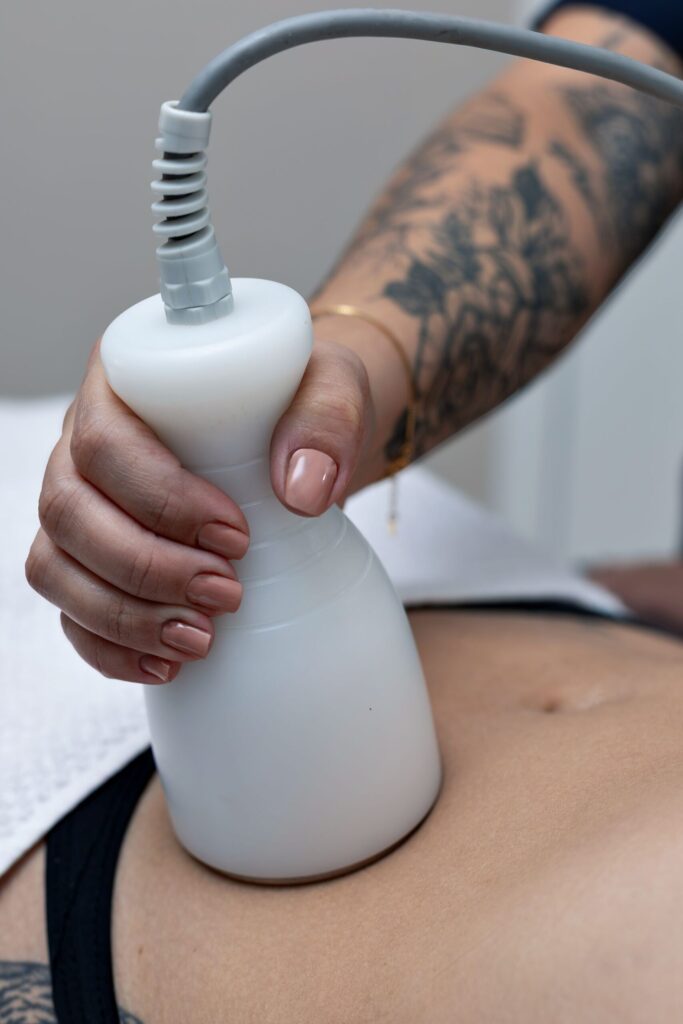
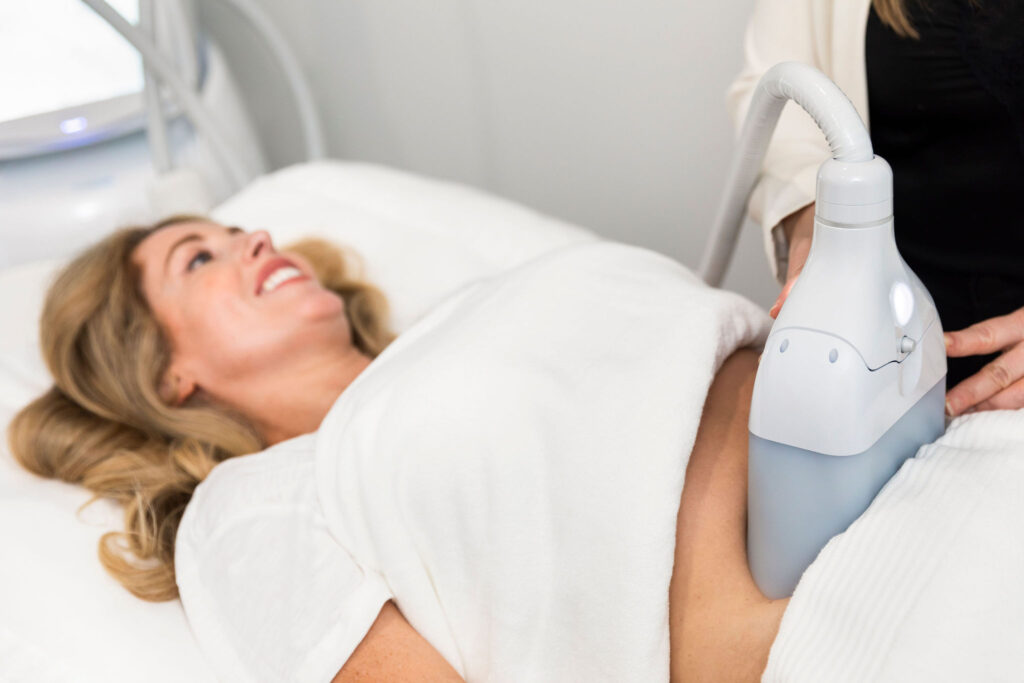
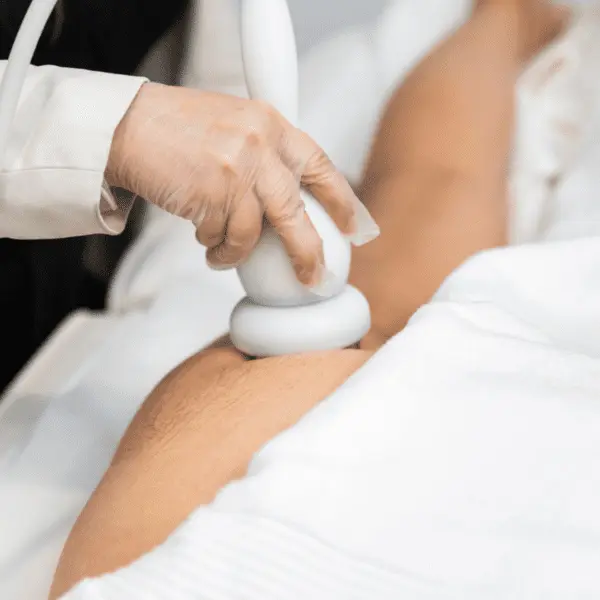
Ultrasonic fat cavitation uses low-frequency sound waves to disrupt and break down stubborn fat cells just beneath the skin – the ones pushing up through the connective tissue and creating that dimpled surface on your thighs and legs. Once disrupted, those cells are converted into free fatty acids and metabolised naturally through your body’s lymphatic system. Fewer, smaller fat cells mean less upward pressure on the skin and a visibly smoother texture.
Stage 2: Radiofrequency (RF) Skin Tightening
RF treatment delivers controlled heat energy deep into the dermis, triggering your body to produce more collagen and elastin, rebuilding the skin’s structure from within. It also assists in liquifying residual fat cells, reinforcing what cavitation has already started. For the thighs and legs, where skin laxity and fat volume often coexist, this combination is particularly powerful.
Stage 3: TeslaFormer Muscle Definer
The TeslaFormer uses Functional Magnetic Stimulation (FMS) to trigger up to 52,000 muscle contractions per session, building a stronger, denser muscle layer beneath the skin that reduces the depth and visibility of dimpling from the inside out.
Just as importantly, TeslaFormer powerfully accelerates lymphatic drainage, helping your body efficiently clear the broken-down fat cells from cavitation. The result is a treatment plan where each stage actively supercharges the next.
Together, these three treatments form the foundation of our Cellulite Buster packs, a sequenced, personalised approach that addresses the structural causes of leg cellulite rather than just the surface.
The most effective approach for most people combines consistent lifestyle habits (strength training, hydration, anti-inflammatory eating) with professional treatments targeting the structural elements that natural methods can’t reach.
If you’re ready to explore your options, book a consultation at your nearest Body Catalyst clinic and let’s build a plan around your body, goals, and lifestyle.